

Written by Sandi James, a registered Psychologist, researcher, and lived-experience clinician with more than 15 years of experience in mental health, eating disorder, and addiction treatment. Sandi’s work focuses on trauma recovery, harm reduction, and more responsive approaches to care, particularly for individuals and communities whose needs are often overlooked.
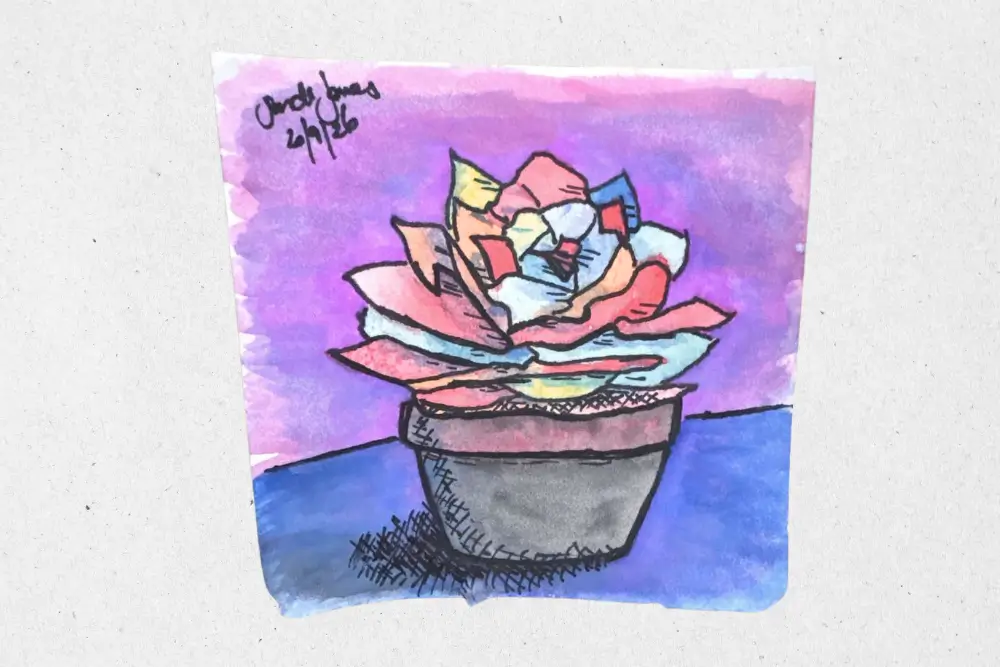
A few months ago, I bought myself a beginner’s watercolor set. Partly because I once used to do a lot of art, mainly when I was studying visual arts for my undergrad degree, partly because I needed a creative outlet to engage with, but mostly because a friend had mentioned that watercolor was supposed to be “forgiving,” and I liked the sound of that.
They were wrong, as it turns out.
Watercolor is not forgiving in the way people mean when they say it. It doesn’t erase your mistakes or let you paint over them the way acrylic does. What it actually teaches you, if you stick with it, is something far more useful than forgiveness.
It teaches you how to work with what’s already happened on the page, rather than fighting to undo it, hide it, or fix it.
I think about this a lot, both as a clinician and as someone who has done my own share of hard, slow rebuilding. Because the way people often talk about overcoming challenges, with resilience, growth, bouncing back, often implies a kind of correction. As though the goal is to return to some clean, unmarked version of yourself, the way the paper looked before you made a wrong move with the brush.
But that’s not how watercolor works, and in my experience, it’s not really how healing or growth work either.
The Water Moves Before You Do
The first thing you learn in watercolor, usually by getting it wrong, is that you are not entirely in control, or in control at all really.
You load your brush, you touch it to the paper, and the water has its own ideas. It spreads further than you intended. It pools in one corner and thins out in another. Two colors that were separate on your palette bleed into each other the moment they meet on wet paper, and there’s no taking that back.
New painters find this terrifying. I certainly did.
I wanted to control the outcome the way I might control a sentence I was writing: to draft it, revise it, get it right, have it look exactly the way I want it to look.
But watercolor doesn’t operate on that logic.
It responds to conditions: how wet the paper is, how much pigment is in the brush, the angle you’re holding the brush at, even the level of humidity in the air.
You can develop skill and intuition through a lot of learning and mistakes, but you can never fully dictate what happens once the water is moving. Water takes its own course. It controls its own destiny. It chooses what it wants to do.
This is, I think, one of the more honest metaphors for what it’s like to go through something difficult.
We have the idea that if we just try hard enough, work hard enough, plan carefully enough, or want it enough, we can control how our story unfolds. But most of the significant challenges in life, a health crisis, a relationship ending, the death of a loved one, an illness, a period of mental unraveling, global instability, don’t respond neatly to effort alone.
The water moves before you do.
Grief spreads further than you expected. Anxiety pools in a corner of your life you thought was unrelated. And no amount of gripping the brush more tightly changes that basic fact.
What changes things is learning to work with the movement instead of against it, noticing where the color is pooling and gently tilting the paper, rather than trying to freeze it in place.
You Cannot Unpaint a Mistake
Here is the part of watercolor that took me the longest to accept: once the pigment is down, it’s down.
You can lift some of it while it’s still wet, blot it, soften an edge, but you cannot return the paper to its original blank state. Every mark becomes part of the history of the piece, whether you meant it to be there or not.
I used to find this unbearable.
I would tense up the moment I made an unintended stroke, wanting to start over on a fresh sheet rather than continue with what felt like a ruined one.
But experienced watercolorists don’t do this.
They keep going.
They look at the “mistake” and ask a different question. They don’t ask, How do I erase this? but rather, What can this become now? How can I adapt and work with it?
A stray wash of color becomes a shadow. An accidental bleed becomes the beginning of a background.
The unintended mark isn’t hidden. It’s incorporated, included, nourished, and accepted.
This is, in my view, one of the more important shifts in how people move through adversity.
So much of the language around overcoming hardship implicitly asks: How do we get back to how it was before?
Before the diagnosis. Before the loss. Before the version of yourself that struggled.
But that paper doesn’t exist anymore.
What exists is the page as it is now, marks and all.
The task isn’t erasure. It’s integration.
What can this become, given that this has already happened?
That’s a fundamentally different question, and a much more workable one.
It doesn’t ask you to pretend the difficulty didn’t happen. It asks you to let it become part of the composition, rather than the thing that ruins it.
Building Up in Layers, Not Getting It Right in One Go
Beginners tend to want the painting finished quickly.
With one confident wash, there it is.
But watercolor doesn’t work that way.
Depth comes from layering: a pale wash first, allowed to dry completely, then another layer over the top, then another, each one building more richness and shadow that a single application could never achieve.
If you try to rush it by piling color onto color before anything has dried, all you get is mud. A flat, murky mess with none of the depth you were hoping for.
There is a discipline in this that I think gets underestimated.
The waiting isn’t wasted time. It’s structurally necessary.
The painting needs the time to dry between layers in order to hold its shape and its depth. Rush it, and you don’t get a faster painting. You get a mess of blurred colors and a lack of clarity and depth.
I see this misunderstood constantly in how people think about their own growth and recovery.
There’s an expectation that healing should move in one continuous, visible wash. That if you’re truly getting better, you should be able to see steady, linear improvement without pause, without backsteps, without confusion.
When progress plateaus, or seems to disappear for a while, people often interpret that as failure or as evidence that nothing is working.
But the pause is frequently where important work is happening beneath the surface, invisible in the moment.
The first layer has to be allowed to set before the next one can be added without turning everything to mud.
Rest, plateaus, and apparent stillness are not always the opposite of progress.
Sometimes they are part of it.
Learning to See What’s Actually There
The single most useful skill watercolor ever taught me had nothing to do with brush technique.
It was learning to really look.
To look at color, at value, at where the light was actually falling, rather than where I assumed it fell.
Beginners paint the shadow they think should be there, based on habit or assumption, rather than the one that’s genuinely present in front of them.
Skilled painters observe first, then respond to what they see.
Overcoming a genuine challenge in life asks something similar of us.
It’s tempting to respond to a hard situation with the reaction we assume we’re supposed to have, or the narrative we think a “resilient person” would tell, rather than looking honestly at and making space for what’s actually there.
What’s truly helping.
What’s really hurting.
Where the light is honestly falling in this particular version of your life, not the generic one we’ve been taught to expect, not in someone else’s version.
That kind of deep observation is slower and less comfortable than reaching for the assumed answer, but it’s the only thing that produces something real and beautiful.
The Finished Piece Was Never Going to Be Flawless
I still have that first watercolor set.
My early paintings are, frankly, really not great. They are murky and muddy in places, overworked in others, full of marks I didn’t intend.
But I keep them.
I cherish them as an honest record of a process, not a failure to reach some imagined, flawless outcome.
I think that’s the piece worth holding onto when we talk about overcoming hardship: the goal was never an unmarked page.
It was never going to be.
The goal is a piece with depth, built in layers, shaped by water that moved in ways you didn’t fully control, incorporating the marks you didn’t plan for rather than hiding them.
That’s not a consolation-prize version of growth.
In watercolor, as in the rest of it, that’s simply what a finished piece actually looks like.
To learn more about Sandi James’s work in trauma recovery, eating disorders, harm reduction, and more responsive approaches to mental healthcare, visit her Expert Profile.
