

Written by Oxana Kirsanova, a wellness entrepreneur, facilitator, and founder of Oneness Wellness Retreats in Costa Rica and Sea2Sky Wellness Club in Canada. Drawing on more than two decades of experience in holistic health and embodiment practices, her work integrates modern therapeutic approaches with ancient healing modalities to support nervous system healing, behavioral transformation, addiction recovery, and sustainable well-being. Through her wellness programs, clinics, and educational work, Oxana helps individuals move beyond survival patterns and reconnect with clarity, self-leadership, and deeper emotional balance
Times are changing. Psychedelics are no longer sitting quietly at the edges of Western culture. They are moving into laboratories, universities, clinical trials, boardrooms, and pharmaceutical pipelines.
The FDA is actively supporting psychedelic drug development. In July 2026, the agency finalized guidance for companies conducting clinical investigations involving psychedelic drugs, and on September 14, it held a public hearing specifically examining their potential future therapeutic use.
The money entering the field tells another part of the story.
UC Davis established an Institute for Psychedelics and Neurotherapeutics with approximately $5 million in university funding to study psychedelics and develop potential treatments.
And pharmaceutical companies are beginning to make much larger moves. In 2026, Eli Lilly announced an agreement to acquire AtaiBeckley for up to $3.8 billion, bringing a psychedelic-based treatment being developed for treatment-resistant depression into one of the world’s largest pharmaceutical companies.
Lots of us practitioners in this industry are watching this unfold and have the same questions that don’t have answers yet.
What happens when something that has been held as sacred becomes a pharmaceutical product?
1. Were Psychedelics Ever Supposed to Be Illegal in the First Place?
Their prohibition was shaped not only by concerns about safety but also by the political and cultural climate of the time.
During the 1960s and early 1970s, psychedelics became closely associated with the counterculture, anti-war movement, and a generation questioning established systems of authority.
The Controlled Substances Act was passed in 1970, followed by President Nixon’s declaration of the War on Drugs in 1971.
As people explored psychedelic substances, many described profound shifts in consciousness, a questioning of conventional beliefs, and a greater sense of freedom and connection.
Some might argue that this created a culture that felt increasingly difficult to fit into, and potentially more difficult for established systems of authority to control.
The history is more complicated than saying this was the single reason psychedelics became prohibited, but the political and cultural context is an important part of the story.
2. Medicine, Tradition and Ownership
Plants have been here long before modern science, clinical trials, pharmaceutical companies, or governments. Many Indigenous communities around the world have worked with plant medicines across generations, developing deep relationships with them through ceremony, culture, spirituality, nature, ancestors, and community.
While these traditions are certainly not all the same, and while the specific practices and medicines involved vary, for many Indigenous traditions, these medicines are not simply molecules to be isolated, packaged, and sold. They are understood as teachers and as part of a living relationship carried from generation to generation.
As the modern world increasingly studies and commercializes these medicines, there is an opportunity to consider not only what science can discover, but also what can be respected and understood from the traditions that have held relationships with them for generations. That includes remembering where knowledge has come from, acknowledging the communities that have preserved it, and remaining open to what ancient traditions may still have to teach us.
3. From Ceremony to Clinic
There is an enormous difference between sitting in ceremony with a medicine that has been carried through generations and sitting in a clinical room with a standardized compound administered under a medical protocol.
Clinical research matters. Safety screening, dosage, preparation, and professional support all matter. But there is another kind of understanding that comes from experience.
Can someone fully understand the depth of these medicines without ever experiencing them?
For many people who work with plant medicine, these experiences can open consciousness in ways that are difficult to explain based on our level of understanding today.
This may become one of the biggest gaps between the clinical world and traditional practice: medical knowledge can tell us a great deal about safety and effects, while lived experience and traditional knowledge can offer another dimension of understanding.
One form of knowledge does not necessarily invalidate the other. Scientific research can help us understand safety, efficacy, mechanisms, and appropriate clinical use, while lived experience and traditional knowledge may offer different insights into context, meaning, and the experience itself.
As research into psychedelic therapies continues to develop, perhaps the more useful question is not which perspective should replace the other, but what each can contribute, and where each is most appropriately applied.
4. From the Earth or the Laboratory?
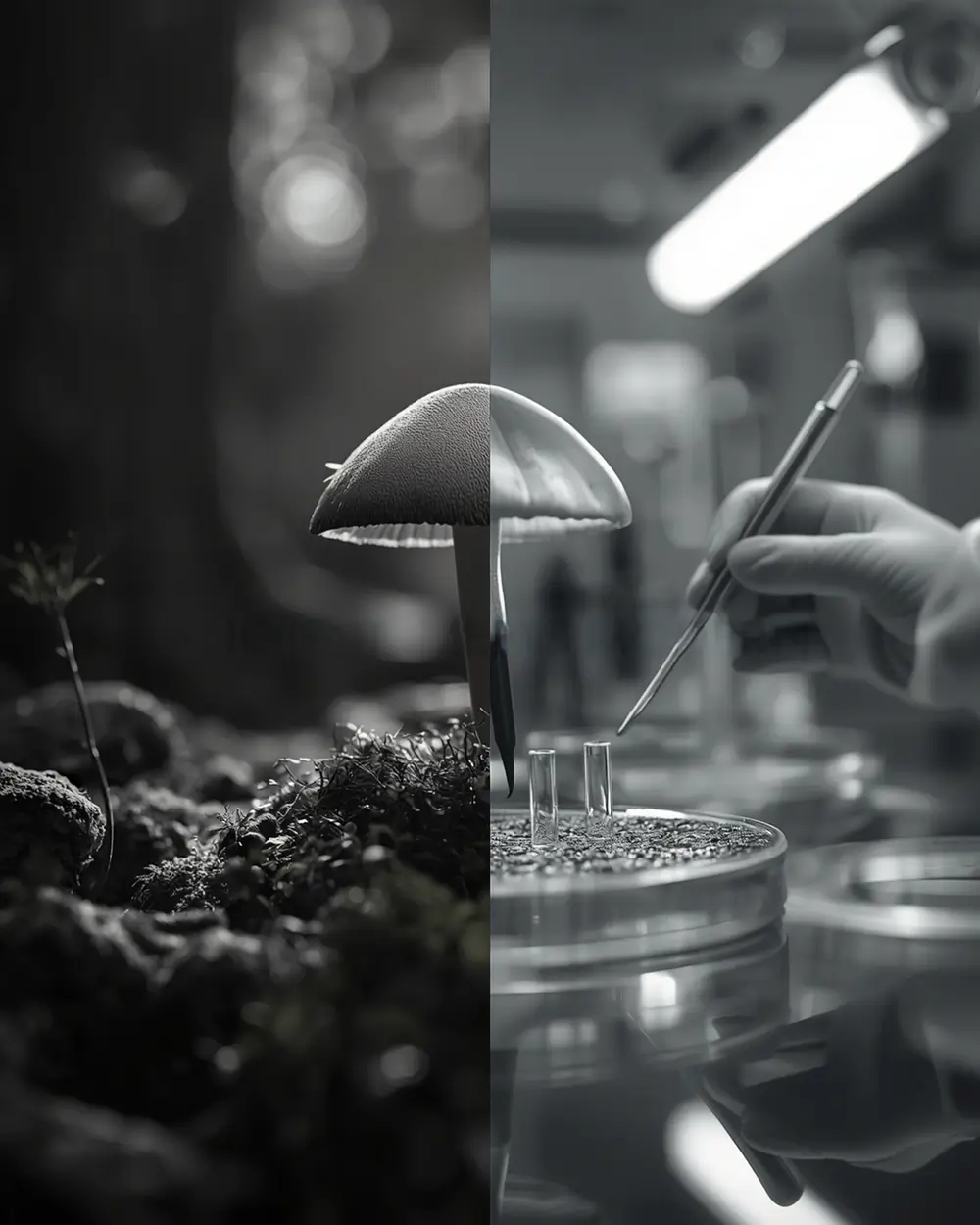
There is also a difference between plant medicine as it comes from the Earth and a pharmaceutical compound created in a laboratory.
A mushroom grows from the Earth, from a living ecosystem, and for many Indigenous traditions, that relationship carries meaning, wisdom, and spirit.
A lab-made compound may contain the same active molecule and may produce similar effects in the body, but from this traditional perspective, something deeper can be missing: the relationship with the Earth and the spirit of the medicine.
Science can measure the molecule and many of its effects, while other dimensions of these experiences cannot yet be fully understood or captured by current scientific models.
There may never be a simple answer to who will shape the psychedelic future.
While we watch ancient medicine meet modern science, thousands of practitioners and Indigenous healers continue quietly doing the work they have done for generations, helping people heal, reconnect, and find their way back to themselves.
They are doing the work they feel called to do, guided by tradition, experience, Mother Nature, and, for many, by God.
As we carry this mission forward, may we remain open to what science can teach us without losing sight of the cultural knowledge, spiritual traditions, and relationships with the Earth that have shaped humanity’s use of some of these medicines for generations.
Continue exploring Oxana’s work.
