

When you’re starting or growing a business, it’s tempting to cut corners on initial expenses. Choosing cheaper equipment might feel like a smart financial move, freeing up cash for marketing, inventory, hiring, or other priorities.
Sometimes it is.
But short-term savings can also lead to significant long-term costs, affecting everything from daily operations to productivity and customer experience.
The smartest purchasing decision is not necessarily the cheapest option or the most expensive one. It is the option that provides the right combination of reliability, performance, lifespan, and cost for the way your business actually operates.
The True Cost of Cheap
The sticker price is only one part of an item’s total cost.
Cheaper equipment can come with hidden costs of purchasing that appear gradually through repairs, replacements, inefficiency, maintenance, and operational disruption.
Imagine a bakery that buys a budget-friendly commercial mixer.
It might work perfectly well at first. But if it repeatedly breaks down during production, the business is not simply paying repair costs. It may also lose sales, delay orders, waste ingredients, pay employees who cannot work efficiently, and disappoint customers.
The money saved on the initial purchase can quickly disappear through lost revenue and emergency replacement costs, a common hidden business cost that growing companies can overlook.
The same principle applies across industries.
A business may save money buying inexpensive office furniture that needs replacing every two years, computers that become unreliable under normal workloads, or tools that cannot tolerate the level of use required.
The important question is not simply, “How much does this cost today?”
It is, “What is this likely to cost us over the period we actually need to use it?”
Look Beyond ROI to Total Cost of Ownership
Smart business owners look beyond the initial price tag when evaluating equipment.
Return on investment can be useful where an asset clearly contributes to revenue, productivity, or cost savings. But for many purchases, total cost of ownership gives an even clearer picture.
That means considering:
- Purchase price
- Expected lifespan
- Maintenance
- Repairs
- Replacement parts
- Energy or operating costs
- Training requirements
- Downtime
- Disposal or replacement
- Potential resale value
Before you buy, it’s worth doing the math and starting to calculate value drivers for your business.
A quality piece of equipment that performs reliably for ten years may be far cheaper overall than a budget option that needs replacing several times during the same period, especially when downtime and repair costs are included.
But the reverse can also be true.
If technology is likely to become obsolete within two years regardless of quality, paying significantly more for a ten-year theoretical lifespan may provide very little additional value.
The useful calculation is not simply quality versus price. It is cost relative to useful life and business need.
Durability Matters Most Where Failure Has Consequences
Some business environments are particularly demanding on equipment.
Commercial kitchens, manufacturing facilities, clinics, workshops, and outdoor businesses may need equipment that can tolerate frequent use, cleaning, moisture, heat, impact, or other challenging conditions.
In those environments, durability can directly affect reliability, hygiene, safety, and productivity.
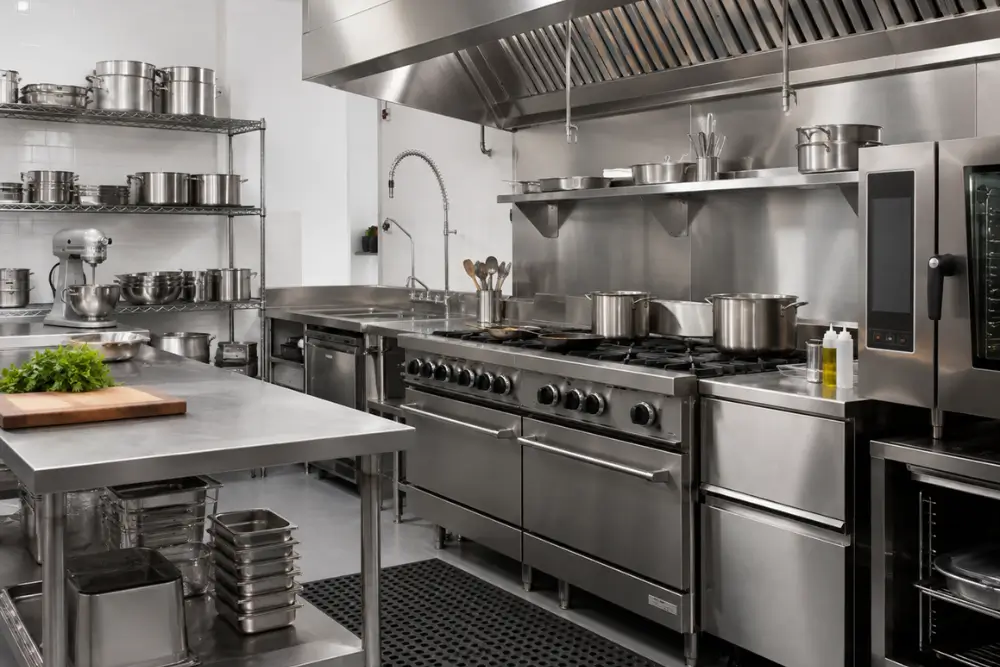
For example, a busy restaurant food-preparation area needs work surfaces suited to repeated cleaning and intensive use. A purpose-built stainless steel bench may provide a more appropriate long-term solution than furniture that was never designed for a commercial kitchen environment.
The same logic applies to workshop tools, delivery equipment, computers, machinery, and other assets.
Buying for the conditions in which something will actually be used is more important than choosing based on price alone.
Equipment designed for occasional use may be perfectly adequate in one business and completely unsuitable in another.
Downtime Has a Cost
Every time essential equipment is unavailable, some part of the business may also become unavailable.
A graphic design company relying on an unreliable computer can miss deadlines and frustrate clients.
A delivery company with vehicles that break down repeatedly can face delays, additional staffing costs, rescheduling, and unhappy customers.
A restaurant without essential kitchen equipment may simply be unable to produce certain items.
Downtime is particularly expensive because the cost rarely appears as a single obvious invoice.
It can show up through:
- Lost sales
- Reduced productivity
- Overtime
- Refunds
- Missed deadlines
- Emergency repairs
- Express replacement costs
- Customer dissatisfaction
- Staff frustration
Reliable equipment can reduce these disruptions and allow employees to spend more time on productive work rather than troubleshooting preventable problems.
That operational stability can become increasingly important as a business grows because more customers, employees, and processes may begin depending on the same systems.
When Cheaper Equipment Is Actually the Smarter Choice
Paying more is not automatically a better business decision.
There are situations where choosing a cheaper option is entirely rational.
If you’re testing a new service, running a short-term event, experimenting with a product line, or buying equipment that will receive very light use, an inexpensive option may be sufficient.
The same applies when technology changes rapidly.
There is little benefit in paying for decades of physical durability if the equipment will become functionally obsolete long before it wears out.
Businesses should also avoid paying for features they do not need.
A small company buying equipment designed for industrial-scale production may spend considerably more without receiving meaningful additional value.
This is where the distinction between cheap and frugal becomes important.
Cheap purchasing focuses mainly on minimizing today’s expenditure.
Frugal purchasing focuses on getting the appropriate value from every dollar spent.
Sometimes that means investing more. Sometimes it means deliberately buying less.
Match the Purchase to the Risk
A useful way to evaluate equipment is to ask what happens if it fails.
For nonessential equipment, failure may be little more than an inconvenience.
For critical equipment, failure could stop production, prevent staff from working, affect customers, or create significant replacement costs.
The greater the consequence of failure, the more weight reliability should receive in the purchasing decision.
Consider asking:
- How essential is this asset to daily operations?
- How expensive would one day of downtime be?
- Is backup equipment available?
- How quickly could it be repaired or replaced?
- How heavily will it be used?
- Does the supplier offer reliable support?
- Are parts readily available?
- What is the expected useful life?
- Will the business outgrow it before it wears out?
These questions create a much more useful purchasing framework than simply comparing prices.
Build a Better Business Asset Base
Changing your perspective from seeing every equipment purchase purely as an expense can lead to better long-term decisions.
Business assets support the company’s ability to operate.
Their value therefore comes not only from what they might eventually be worth on resale, but from what they allow the business to do reliably while they are being used.
Well-chosen equipment can help maintain capacity, reduce replacement frequency, support productivity, and make future costs easier to anticipate.
This becomes increasingly important when planning expansion or evaluating how much additional investment the company will need.
A potential buyer or investor assessing a business may care not simply about how much its equipment originally cost, but about its condition, usefulness, remaining life, maintenance requirements, and how much capital will soon need to be spent replacing it.
A business full of expensive assets that are obsolete or poorly maintained is not necessarily stronger than one that has purchased more selectively.
The aim is to build an asset base that genuinely supports the operation.
Buy for Value, Not Price
Building a resilient business requires a long-term view.
Saving money is important, particularly when cash is limited. But reducing expenditure and reducing value are not the same thing.
Before making a significant equipment purchase, look beyond the price tag.
Consider how long you expect to use it, what happens if it fails, how often it will need maintenance, whether the business might outgrow it, and what disruption replacement could create.
Quality is valuable when the business benefits from that quality.
The smartest purchase is therefore not automatically the cheapest or the most premium option.
It is the one that delivers the right level of performance, reliability, and useful life at the lowest sensible total cost to the business.
