

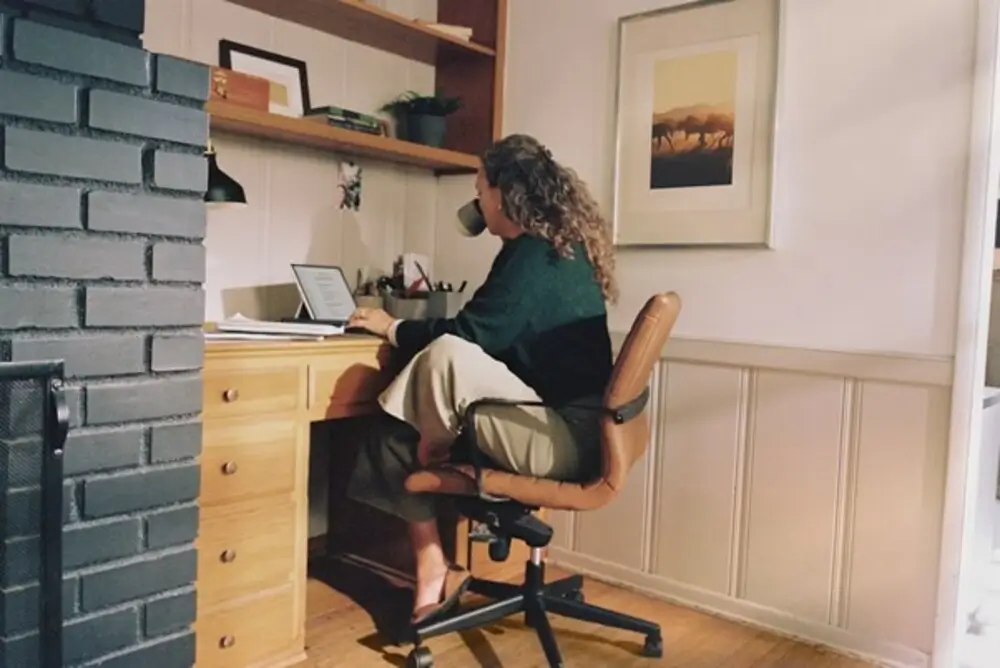
For many founders, the distinction between home and workplace has become increasingly difficult to draw.
The dining table becomes a packing station. Product samples fill a spare room. Client calls happen from the bedroom. Business paperwork lives beside household bills, and the laptop remains visible long after the workday was supposed to end.
Working from home can provide enormous flexibility, particularly during the early stages of building a company. But the same flexibility can gradually allow the business to occupy more physical and mental space than intended.
The answer is not necessarily a beautiful dedicated office or a perfectly separated working life. It is creating enough structure that the business can function without taking over the entire home.
That means thinking about space, storage, equipment, digital systems, and time together rather than treating the home office as a decorating project.
Create a Work Zone That Fits the Space You Actually Have
A separate home office can make boundaries easier, but it is not realistic or necessary for everyone.
A desk in a bedroom, a corner of a living room, or even a dining table may need to perform several functions throughout the week. The important question is whether the setup allows work to begin and end with some degree of intention.
A dedicated work surface can help. So can arranging equipment so that frequently used items have a consistent place.
If the space has to serve multiple purposes, a pack-away system may be more useful than pretending it is a permanent office. A box, cabinet, cart, or drawer can hold the laptop, notebooks, documents, and accessories so that they can be removed from view when work is finished.
The principle behind good office design applies even at a very small scale: the environment should support the work being done rather than creating unnecessary friction around it.
For a home-based founder, flexibility may matter more than creating a conventional office.
Use Physical Boundaries as Cues, Not Rules
Physical separation can support psychological separation from work, but the relationship is not automatic.
Leaving a desk at 6 p.m. does not guarantee that you stop thinking about customers, cash flow, or tomorrow’s workload. Equally, someone may work successfully from the kitchen table and still maintain clear boundaries around working time.
The value of a defined work zone is that it creates a cue.
Opening the laptop, arranging the desk, or moving into a particular room can signal the beginning of work. Closing the computer, putting equipment away, or leaving the room can help create a transition back into personal time.
Research into work-home boundaries has found that psychological detachment from work is associated with recovery and that clearer boundaries around work-related technology can help some people disengage during nonwork time.
That does not mean everyone needs the same boundary style.
The useful question is whether your current environment makes it reasonably easy to stop working when you intend to.
Remove What Is Competing With the Workspace
Clutter is often described as inherently stressful, but the practical problem is simpler: too much material in a limited space can make that space harder to use.
Home-based founders can accumulate packaging, samples, stock, files, photography equipment, promotional materials, returns, stationery, and other items remarkably quickly.
The first step is to distinguish between what needs to be immediately accessible and what merely needs to exist.
Frequently used items deserve convenient storage near the workspace. Old documents may belong in an archive. Inventory may need shelving or a dedicated room. Materials that are rarely needed should not necessarily occupy valuable everyday living space simply because they belong to the business.
The objective is functional space rather than minimalism.
Know When the Home Has Reached Its Storage Limit
There is a point at which better organization stops solving the problem.
If boxes occupy bedrooms, inventory blocks hallways, or business materials repeatedly need to be moved before the family can use a room, the company may simply be asking more of the property than it can comfortably provide.
External self storage can be one solution, particularly for stock, equipment, records, exhibition materials, or other items that need to be retained but not accessed constantly.
However, moving things elsewhere creates its own considerations. Monthly cost, travel time, access hours, security, insurance, environmental conditions, and the frequency with which stock needs to be retrieved all affect whether off-site storage actually improves the operation.
If employees need the inventory several times a day, a storage unit twenty minutes away may create more friction than it removes.
Storage should therefore follow workflow.
The question is not simply how to get business items out of the house, but where those items can be stored while still supporting the way the business operates.
Think About Inventory as an Operational System
Founders selling physical products face a particular challenge because inventory can make the home feel less like a workplace and more like a small warehouse.
As the business grows, it becomes useful to think beyond where boxes physically fit.
Where are goods received? How are they counted? Where are returns kept? Which stock moves frequently? Where does packing happen? Can the founder quickly tell how much stock is actually available?
Poor storage creates more than visual inconvenience. It can make products harder to find, increase handling, and make inventory records less reliable.
Sometimes shelving and labeling are enough.
Sometimes the better decision is moving part of the operation elsewhere.
The threshold is not whether working from home still feels entrepreneurial. It is whether the home continues to support the business efficiently enough for its current scale.
Build a Workstation Around Your Body
A makeshift workspace often begins with whatever furniture is already available.
That can work for occasional tasks. It becomes more important to think about the setup when someone spends several hours there every day.
An expensive ergonomic chair is not automatically necessary, but adjustability and support matter. The chair, desk, keyboard, mouse, and monitor need to work together rather than forcing the body into awkward positions for extended periods.
OSHA’s computer-workstation guidance recommends arranging equipment to support neutral postures, keeping commonly used items within easy reach, supporting the feet and back, and positioning the monitor to reduce awkward neck and head positions. It also notes that laptops create particular ergonomic challenges when they are used as primary work computers for intensive keyboard work.
For founders working primarily from a laptop, a separate keyboard, mouse, or monitor may sometimes create more practical value than buying a collection of productivity accessories.
Start with the discomfort or limitation you are actually trying to solve.
Lighting Should Help You See the Work Comfortably
Good lighting matters, but it does not need to be framed as a guaranteed mood or productivity enhancer.
The practical objective is visual comfort.
Poor positioning can create screen glare, make text difficult to see, or encourage awkward postures as someone repeatedly adjusts their position to see the screen.
OSHA advises arranging workstations to minimize glare and selecting lighting appropriate to the task and screen environment.
Natural light may be pleasant when available, but the ideal setup will depend on the room, working hours, windows, screen position, and type of work.
A good workspace is one you can comfortably use for the time the work requires.
Do Not Turn the Home Office Into a Shopping Project
Once a founder decides the workspace needs improvement, it is easy to buy a succession of solutions.
A larger monitor. New desk. Headphones. Standing mat. Cable organizer. Webcam. Microphone. New productivity app.
Some of those purchases may genuinely help.
Others simply add expense and more objects to manage.
Before buying something, identify the problem.
If calls are difficult because of household noise, headphones may be useful. If neck discomfort comes from spending all day looking down at a laptop, monitor positioning deserves attention. If papers repeatedly disappear, better document storage may matter more than another digital task-management tool.
The strongest setup is not the one with the most equipment.
It is the one that removes recurring friction from the work you actually do.
Be Selective About Digital Tools Too
Physical clutter has a digital equivalent.
Home-based founders can accumulate task-management platforms, messaging apps, cloud-storage accounts, calendars, note-taking tools, accounting systems, social-media schedulers, and automation services.
Each may be useful individually while the overall system becomes harder to manage.
Tools such as Asana or Trello can help when the work genuinely benefits from structured project management, but a solo founder with a straightforward workload may be perfectly well served by a simpler system.
Technology should reduce the number of things you need to remember or coordinate.
If maintaining the tool becomes another task, reconsider whether it is earning its place.
Protect Attention as Carefully as Square Footage
A home workspace can be physically organized and still feel impossible to work in if attention is continuously interrupted.
Household activity, deliveries, messages, email, social notifications, and the knowledge that domestic tasks are only a few steps away can all compete with work.
Not every interruption needs to be eliminated.
The useful distinction is between interruptions you choose and those that repeatedly break concentration without adding value.
Turning off nonessential notifications, using focused periods for particular kinds of work, or communicating important working times to other people in the household may help.
Noise-canceling headphones may be useful in some environments, but they are not a universal requirement. In others, simply closing a door, changing where calls happen, or working during quieter periods may solve the problem.
Design around the actual source of distraction.
Give the Business Hours as Well as Space
Physical boundaries become much less useful if the working day has no boundary.
Founders frequently have good reasons to work unconventional hours. Flexibility may be one of the reasons they started the business in the first place.
The objective is therefore not necessarily a rigid nine-to-five schedule.
It is having enough intentionality around when work happens that every available hour does not gradually become a potential working hour.
This is especially important when following any guide on starting a business that places heavy emphasis on constant activity, growth, and execution.
You may choose different hours on different days. You may work evenings while caring for children or start early because that suits you better.
What matters is knowing when you are working by choice rather than simply remaining permanently available to the business.
Create Boundaries Around Communication
One reason work follows founders around the house is that the office is no longer the only place where work reaches them.
Email, messaging platforms, social media, customer notifications, and mobile apps travel everywhere.
A practical boundary might mean switching off nonessential notifications after a particular time. It might mean keeping work email off a personal tablet or using separate profiles on a phone.
It could simply mean deciding that messages received after a certain hour will be answered the next day unless they meet a genuinely urgent threshold.
The exact rule matters less than removing the expectation that everything deserves an immediate response.
Availability is a business decision, not an obligation created by owning a smartphone.
Do Not Schedule Every Minute of Recovery
The original article recommends scheduling downtime as firmly as business appointments. For some founders, putting personal time into the calendar is useful because otherwise work expands into it.
However, there is a point at which rest can start feeling like another productivity task.
Not every hour needs a defined purpose.
Protecting time in which nothing specific has to happen can be just as important as scheduling a hobby, exercise class, or social event.
The purpose of boundaries is not to optimize every part of life.
It is to prevent the business from automatically claiming whatever remains.
Allow the Workspace to Change With the Business
The home office that works when you are testing an idea may not be appropriate once the company has employees, substantial inventory, frequent customer visits, specialist equipment, or more complex operations.
That does not mean success requires immediately moving into commercial premises.
It does mean periodically asking whether the current environment is still helping.
Women continue to play an increasingly visible role in entrepreneurship and are part of the changing future face of business, but there is no single physical model that a successful female founder needs to adopt.
Some businesses can remain home-based indefinitely.
Others eventually need a studio, warehouse, coworking space, storage facility, office, or hybrid arrangement.
The right transition point is operational rather than symbolic.
Move because the next environment solves a genuine constraint, not because success is supposed to look a particular way.
Your Home Does Not Need to Become a Corporate Office
A home-based business works because the home can serve purposes that traditional workplaces cannot.
It can reduce overhead, eliminate commuting, provide flexibility, and allow a founder to design work around the realities of her life.
Those advantages should not disappear because the space is being made more “professional.”
The objective is not to reproduce an office building inside your house.
It is to create an environment that supports focused work while allowing the rest of the home to continue functioning as somewhere you actually live.
Sometimes that means better furniture or storage. Sometimes it means fewer tools, firmer communication boundaries, or moving inventory elsewhere.
The best work-life space is not the most impressive one.
It is the one that allows the business to operate without requiring the founder’s entire home, attention, and personal time to become part of the company.
